I started working out again last week. Who knows how long this will last, as I'm pretty bad about sticking to things like this, but I'm doing what I can. I determined that I prefer walking (even occasionally running--gasp!) on the indoor track, rather than being stationary on an elliptical machine or bike.
The indoor track at my preferred Y location is 18 laps to a mile. As I started my walk today, I tried to think of a way to both focus my thoughts as I walked and keep track of what lap I'm on. What came to mind was a wonderful exercise in reflection and gratitude. I let the number of the lap be a prompt for things in my life to be thankful or prayerful for as I walked.
ONE holy God, Creator, Redeemer, and Sustainer of the world.
TWO darling daughters, and all the Mommy-Daughter fun we have. I wanted girls so badly, and though I now have a beautiful son to love as well, I marvel at the two awesome girls I get to mother.
THREE precious children: fireball Kate, cheerful Claire, and sweet baby Jonah. I love them so!
FOUR years in Brentwood, living in our lovely home, close to things we enjoy, and just three miles from Matt's parents.
FIVE members of our family. What fun we have and how I love our little family!
SIX seats at the table. Both our kitchen table and dining room table each have six chairs around them. With four of us currently using chairs, and Jonah who will eventually sit in one, that means we always have room for at least one more: a guest, a foster child, another child, etc.
SEVEN days in a week, time to be productive and time to rest. (Just picturing a page in my planner makes me smile!)
EIGHT weeks of Jonah! The joyful rest of my days getting to know my sweet boy, and thankfulness for his health and mine, especially in light of so many I know who've had traumatic births and postpartum experiences.
NINE years of marriage. Matt is such a loving husband and great father. It's not always easy, but as Andrew Peterson says, "that's what the promise is for."
TEN years in publishing. I love my work and have a great career going!
ELEVEN . . . praying for some eleven year old out there going through a tough time. I couldn't think of anything personal for this number, but middle school is rough . . .
TWELVE years in Nashville (well, the Nashville area). I came for Vanderbilt Divinity School and stayed because of Matt. Four years in Midtown, four in Clarksville, and now four in Brentwood. I love my hometown of Louisville, but being a Tennessean isn't so bad either!
THIRTEEN years old when I switched to private school. Seventh grade was wretched for me, and for eighth through twelfth grade, I thrived in a much smaller educational environment where I could participate in a lot of activities and hold several leadership roles.
FOURTEEN years of studying religion. Choosing the religion major at Furman University enhanced my faith and changed my thinking, my politics, my personal and professional life, and maybe in some small way, the world, as it's given me a more global and missional perspective.
FIFTEEN minutes of walking (by the second mile, that is, as I counted back down from 18. I couldn't think of anything for fifteen the first time!) Thankful for my body, my health, the ability to walk, and a nice facility with childcare in which to work out!
SIXTEEN years since high school. Adulthood has been pretty good so far.
SEVENTEEN days left in the year. Seventeen days to relax, spend time with family, and celebrate the birth of Christ. And 21 days left in my maternity leave--eek!
EIGHTEEN years at home. Thankful for my happy childhood and wonderful parents. Day trips and vacations, history lessons, traditions, and family dinners.
18 laps--well, 36, actually. Two miles thinking on such things made me feel grateful, proud, and happy with my life. Sure beats a half hour pondering my jiggly thighs or envying the fit aerobics instructor leading a class in the gym below. And it made my cardio time fly by! I moved on to the weight room with a peace I carried on to pick up my sleeping son from the nursery and out into the surprising warmth of a December day.

Showing posts with label faith. Show all posts
Showing posts with label faith. Show all posts
Monday, December 14, 2015


Wednesday, November 19, 2014
Advent Inspiration
Having edited books, a magazine, and a website, I've learned the quirks of the timelines of each media type.
When I edited Ministry Matters, we had to be useful to pastors in their planning for various seasons and events of the church year. So, we kicked off our Advent content with a "Christmas in July" week to help pastors planning their sermons, worship, and outreach efforts for the following November and December.
When I edited Circuit Rider, a quarterly magazine for United Methodist leaders, each issue went to prepress about 6-8 weeks before it arrived in mailboxes, and work on the issue began months before that. So, the issue pastors might read as Advent draws close was on my brain way back in the spring.
Book publishing takes a lot longer. This is surprising for a lot of first time authors, I find. They spend six months or a year (or more, depending on the book) working on a book and are disheartened to hear that it will likely be almost another year before it hits the bookshelves (or the preorders are finally shipped, as the case may be in this online age). So with 9-12 months' gap between manuscript and release, I was working on Advent books way back in . . . the previous Advent!
Yes, this long timeline actually worked out nicely in that last year I had the pleasure of working on Advent books actually DURING Advent! Rather than the dissociative state of writing "plan your summer mission trip" at Christmastime, I got to sit by the tree as I edited, wrote, and compiled essays, prayers, and biblical reflections about incarnation, messianic hopes, preparing for Jesus' coming, and the kingdom of God.
It was a special thing, and now (a year later) I get to share those amazing Advent books with YOU to inspire you THIS Advent . . . which starts in only ten days--whoops!--better order fast!

Every Valley: Advent with the Scriptures of Handel's Messiah
If you love Handel's Messiah, love Christmas music, or love anybody who's into sacred music, this book is a gem. It has forty reflections (good, theological stuff--not just fluff) exploring the scriptures that make up the libretto of Handel's Messiah. From "Comfort ye, comfort ye" (Isaiah 40:1-5) to "Amen" (Revelation 5:14) and every "behold" and "hallelujah" along the way, these essays from a variety of pastors and theologians dig into the meaning behind every Bible passage in the oratorio. Good for a daily Advent devotional, reading by the tree, or gifting to your favorite choir director.

Feasting on the Word Advent Companion
This one is for the pastor in your life (or, knowing a lot of our friends, YOU!) Part of WJK's popular "Feasting on the Word" line of preaching and worship resources, this one offers ideas and tools for Advent and Christmas. Planned thematically (not by the lectionary) this book includes sermon-prep Bible commentaries and complete worship services for the four Sundays of Advent, four midweek services, Christmas Eve and Christmas Day.
It's a bit late to use for this year's Advent (unless you're a last-minute kind of guy or gal) but maybe for next year. Plus, there is also a Feasting on the Word Lenten Companion for your Lent and Easter planning!
When I edited Ministry Matters, we had to be useful to pastors in their planning for various seasons and events of the church year. So, we kicked off our Advent content with a "Christmas in July" week to help pastors planning their sermons, worship, and outreach efforts for the following November and December.
When I edited Circuit Rider, a quarterly magazine for United Methodist leaders, each issue went to prepress about 6-8 weeks before it arrived in mailboxes, and work on the issue began months before that. So, the issue pastors might read as Advent draws close was on my brain way back in the spring.
Book publishing takes a lot longer. This is surprising for a lot of first time authors, I find. They spend six months or a year (or more, depending on the book) working on a book and are disheartened to hear that it will likely be almost another year before it hits the bookshelves (or the preorders are finally shipped, as the case may be in this online age). So with 9-12 months' gap between manuscript and release, I was working on Advent books way back in . . . the previous Advent!
Yes, this long timeline actually worked out nicely in that last year I had the pleasure of working on Advent books actually DURING Advent! Rather than the dissociative state of writing "plan your summer mission trip" at Christmastime, I got to sit by the tree as I edited, wrote, and compiled essays, prayers, and biblical reflections about incarnation, messianic hopes, preparing for Jesus' coming, and the kingdom of God.
It was a special thing, and now (a year later) I get to share those amazing Advent books with YOU to inspire you THIS Advent . . . which starts in only ten days--whoops!--better order fast!
Every Valley: Advent with the Scriptures of Handel's Messiah
If you love Handel's Messiah, love Christmas music, or love anybody who's into sacred music, this book is a gem. It has forty reflections (good, theological stuff--not just fluff) exploring the scriptures that make up the libretto of Handel's Messiah. From "Comfort ye, comfort ye" (Isaiah 40:1-5) to "Amen" (Revelation 5:14) and every "behold" and "hallelujah" along the way, these essays from a variety of pastors and theologians dig into the meaning behind every Bible passage in the oratorio. Good for a daily Advent devotional, reading by the tree, or gifting to your favorite choir director.
Feasting on the Word Advent Companion
This one is for the pastor in your life (or, knowing a lot of our friends, YOU!) Part of WJK's popular "Feasting on the Word" line of preaching and worship resources, this one offers ideas and tools for Advent and Christmas. Planned thematically (not by the lectionary) this book includes sermon-prep Bible commentaries and complete worship services for the four Sundays of Advent, four midweek services, Christmas Eve and Christmas Day.
It's a bit late to use for this year's Advent (unless you're a last-minute kind of guy or gal) but maybe for next year. Plus, there is also a Feasting on the Word Lenten Companion for your Lent and Easter planning!
Tuesday, December 31, 2013
7 Swans a Swimming
I feel rather delinquent in not sharing any photos of our family Christmas celebrations yet, but I am here to say—to myself as well as you—Christmas is not over yet!!
I find myself so frustrated with how quickly the world moves on from Christmas after Dec. 25. Even the Christian radio station stopped playing Christmas music at 5 pm on the 25th! They couldn't even wait until midnight?! Dec. 25 is just the beginning, the first day of Christmas. We could be enjoying twelve days, people! (Count them: Dec. 25 to Jan. 5; Jan. 6 is Epiphany, the start of the next season in the church year.)
I wrote a post about this several years ago called "Christmas Is the New Advent," saying essentially that the twelve days of Christmas are actually a better time for reflection and celebration of Emmanuel, God with us, precisely because most of society has already moved on. Without the pressure of "getting ready" for Christmas, buying and wrapping and baking and all (all of which I love), now is the best time to simply enjoy the season and think about what it means for Christ to have come as an infant, even when the festivities are done and we're back to the old grind of work and school.
Like so many families, we have our practices during Advent to help the kids (and us) to countdown and prepare for Christmas—Advent calendars, nativity scenes, keeping the baby Jesus figurine out of the manger until Christmas Eve, etc.—but how do we help the kids celebrate Christmas even after all the gifts are opened?
 I started by telling the kids about the twelve days of Christmas, singing the song to introduce the concept and then announcing each day what day of Christmas it is. (Today is the Seventh Day of Christmas!) Kate has been keeping track even better than we have! Then, I transformed our Advent wreath into a Christmas wreath. Well, we just had a plate this year, no greenery, but in any case, out went the four purple candles and in went twelve tea lights. We light the Christ candle that was first lit on Christmas Eve to symbolize Christ's presence with us, and then light the appropriate number of tea lights.
Last year, we had a Twelfth Day of Christmas party to take down our decorations, drag out the tree, and demolish our gingerbread house. It's a fun way to mark the changing of the seasons, having carried our celebration of Jesus' birth beyond the gifts and big meals, back into everyday life.
I find myself so frustrated with how quickly the world moves on from Christmas after Dec. 25. Even the Christian radio station stopped playing Christmas music at 5 pm on the 25th! They couldn't even wait until midnight?! Dec. 25 is just the beginning, the first day of Christmas. We could be enjoying twelve days, people! (Count them: Dec. 25 to Jan. 5; Jan. 6 is Epiphany, the start of the next season in the church year.)
I wrote a post about this several years ago called "Christmas Is the New Advent," saying essentially that the twelve days of Christmas are actually a better time for reflection and celebration of Emmanuel, God with us, precisely because most of society has already moved on. Without the pressure of "getting ready" for Christmas, buying and wrapping and baking and all (all of which I love), now is the best time to simply enjoy the season and think about what it means for Christ to have come as an infant, even when the festivities are done and we're back to the old grind of work and school.
Like so many families, we have our practices during Advent to help the kids (and us) to countdown and prepare for Christmas—Advent calendars, nativity scenes, keeping the baby Jesus figurine out of the manger until Christmas Eve, etc.—but how do we help the kids celebrate Christmas even after all the gifts are opened?

Last year, we had a Twelfth Day of Christmas party to take down our decorations, drag out the tree, and demolish our gingerbread house. It's a fun way to mark the changing of the seasons, having carried our celebration of Jesus' birth beyond the gifts and big meals, back into everyday life.
Sunday, March 17, 2013
Taking Stock of Our Time
This past week's Lenten challenge in our church's "Taking Stock" series was taking stock of our time, and I have to admit, I was just no good at this one.
Oh, I take stock of my time, alright, in a super-organized, Type A sort of way. I use an online time tracker (Yast.com) to keep track of the hours I spend on various work projects (especially important now that I'm freelancing and paid by the hour, in some cases) and I write things in my planner even after the fact so that I have a record of how I spent my time. But the specific challenge this last week was to carve out ten minutes for prayer and devotion each day, and I have to admit that more days than not, I just forgot.
I pray a lot, in that I talk to God throughout the day and try to live ever-mindfully of God's presence and will for our lives, but I really struggle to sit down and focus only on prayer for a period of time. To stay focused, I generally need a pencil in hand, to underline lines of scripture that strike me as I read it, or to write and sketch my prayers creatively. Judging from these two extremes, it seems I have trouble just doing "nothing." What a shocker. I can go about normal life prayerfully, or I can productively draw, write, annotate, etc. Just sitting and "being" in the presence of God is tough for me on an ordinary basis. When I think of times I am able to do that, it's generally when I've gotten "away from it all" in a cabin or whatnot, and sit in an Adirondack chair with a mug of coffee, just staring out over glorious hills and trees.
This week is "taking stock of our relationships," being mindful of the people we come into contact with each day and the health of each of those relationships, particularly any anger or grudges we may need to let go of.
Oh, I take stock of my time, alright, in a super-organized, Type A sort of way. I use an online time tracker (Yast.com) to keep track of the hours I spend on various work projects (especially important now that I'm freelancing and paid by the hour, in some cases) and I write things in my planner even after the fact so that I have a record of how I spent my time. But the specific challenge this last week was to carve out ten minutes for prayer and devotion each day, and I have to admit that more days than not, I just forgot.
I pray a lot, in that I talk to God throughout the day and try to live ever-mindfully of God's presence and will for our lives, but I really struggle to sit down and focus only on prayer for a period of time. To stay focused, I generally need a pencil in hand, to underline lines of scripture that strike me as I read it, or to write and sketch my prayers creatively. Judging from these two extremes, it seems I have trouble just doing "nothing." What a shocker. I can go about normal life prayerfully, or I can productively draw, write, annotate, etc. Just sitting and "being" in the presence of God is tough for me on an ordinary basis. When I think of times I am able to do that, it's generally when I've gotten "away from it all" in a cabin or whatnot, and sit in an Adirondack chair with a mug of coffee, just staring out over glorious hills and trees.
This week is "taking stock of our relationships," being mindful of the people we come into contact with each day and the health of each of those relationships, particularly any anger or grudges we may need to let go of.
Saturday, March 02, 2013
Taking Stock of Our Pantry

This week, for our Lenten challenge, we were taking stock of our pantries by living off of the items that are included in a food box from our church's food pantry. It's a specific variety of canned goods, spaghetti, peanut butter, etc. It costs around $40 total. (We use this cute illustrated shopping list so Kate can help pick out items for the food pantry while we're grocery shopping.)
Matt's sermon last Sunday was really good, not just pointing out the reality of our community (3/4 of our county's public school kids on free or reduced lunch!) but examining the story of the feeding of the 5000 in ways I hadn't thought of before. First, that the idea of communal responsibility is assumed. The disciples don't approach the problem from a perspective like, "these people are getting hungry, we need to end the sermon!" or "they should have brought a picnic!" but automatically, "Where will we get enough food to feed all these people?" And secondly, that Jesus doesn't perform a miracle ex nihilo (out of nothing). He uses the bread and fish one boy brought, using what we have and what we bring to feed others. Connected with Jesus' refusal to turn stones into bread at Satan's tempting (preached on the week before) this especially made a good point.
One of our main family values is gratitude, so I'd like to think I look at our pantry pretty often with thanks for all that we have. We are fortunate to be able to buy the food we like and want in the quantities we like. Health plays more of a restraining role than money, usually. (Though I might buy more fancy cheese every week if we had unlimited funds. Cheese is my weakness.) It was a new experience, though, having to eat what "someone else" picked out for me.
We went grocery shopping as a family last Sunday afternoon, and while I picked out a couple soups myself, Matt grabbed the first chili he saw to add to the cart. "No!" I cried. "I want to pick out the chili" (since Matt doesn't care for chili and it would be me eating it anyway). Matt quickly reminded me that folks receiving a food pantry box don't get any choice about the veggie, meat, bean, or calorie content of their chili.
It looked and tasted like dog food, by the way.
I ate it for lunch on Monday. It was 32 grams of fat per can. Not what I would have chosen. Breakfast was healthier (instant oatmeal and applesauce) though I really wanted an egg white and english muffin. Ah well. Choice and health seemed to be the big things sacrificed in this experiment. Taste, too, being left with peanut butter and saltine crackers for a snack, rather than kalamata olives and wheat crackers, or whatever. But it was a little bit frustrating.
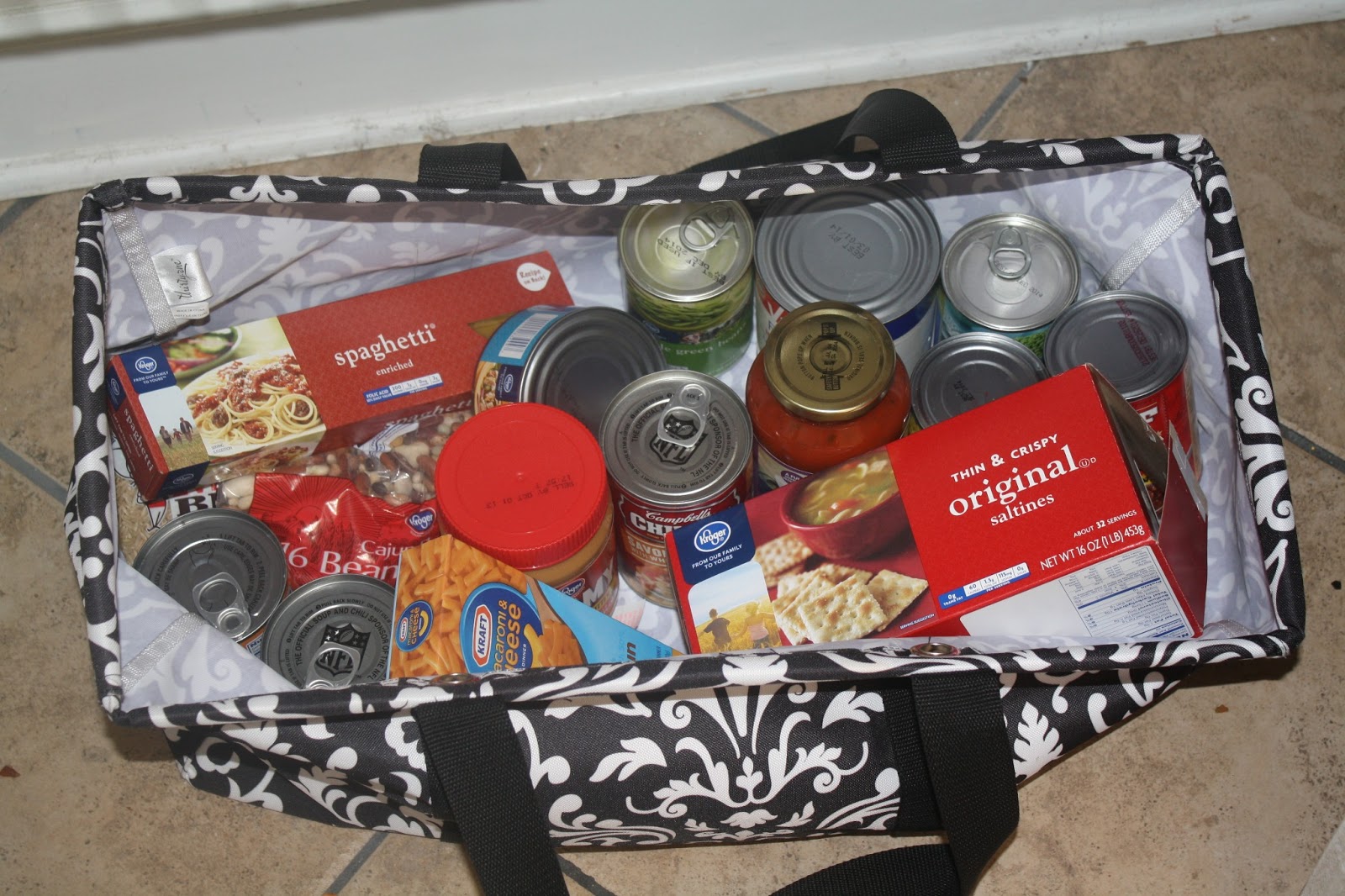 |
| Our pantry for the week. |
 |
| I even blocked off a couple shelves, so I would remember not to tap into our other snacks, seasonings, or canned goods. (Cereals and cooking oil were still fair game, I figured.) |
We continued to eat any perishables we already had in the fridge, but I ran out of coffee creamer on Tuesday and was grateful we still had some milk left. I can't imagine what it would be like to need a carton of milk and not be able to afford it. And it made me ever more aware of the lack of fresh produce in poor areas. I was able to add some zucchini we already had to our spaghetti, and the kids devoured the applesauce and fruit cocktail. We need fresh fruits and vegetables, which are generally not available from traditional food banks.
This coming week, we'll be taking stock of our closets, and I look forward to purging all the clothes that no longer fit or I just don't wear. Jesus' statement "I was naked and you gave me clothing," may seem far fetched in this day and age, but there is still a need for free and cheap clothing for those who need it, and perhaps moreso for the more affluent among us to realize how much we have and learn to live more simply, so that we may live more generously.
Saturday, February 23, 2013
Taking Stock
For Lent this year, Matt is leading our congregation in a series/experience called Taking Stock. Each week, we'll be examining a certain area of our lives, taking stock of what we have, what is excess, and what we can use to help others. While people may still give up something or take on another practice for Lent, we'll be challenging people with a certain week-long practice or focus each week of Lent. I thought I'd try to share a weekly reflection to keep me accountable and process my thoughts.
Last week was the first Sunday of Lent, so Matt introduced our Lenten theme and asked people to take an overall look at their lives (before we got to the specific challenges of coming weeks) just to be aware of how we spend our money, time, and energy, taking stock of any excess we noticed.
My initial thought was the excessive laziness of my evenings. After the kids are in bed, I typically spend a couple hours on the couch or at my kitchen desk, watching TV, reading blogs and Facebook, drinking wine and munching on non-nutritive snacks. It feels pretty slothful, given that I "should" be doing laundry, dishes, working some more, etc. But, I got over that pretty quickly. Yes, I should cut back on the empty calories, but overall, this is my relaxation time that I relish after a day of working and kid-wrangling. So while it isn't an absolute necessity, I don't consider my "me time/couple time" excessive, exactly. Though if I think about people who don't have enough to eat to nourish themselves at all, the fact that we rich folk can basically eat recreationally is quite excessive.
I also thought of things like our energy usage. Leaving lights on accidentally, loading the dishwasher with things that could easily be cleaned by hand, taking two cars to church just so the kids and I don't have to go early or stay late for Matt, etc. are all issues to be examined.
It was when I did our monthly budget assessment this week that the excesses became more apparent. (I have tried Quicken as New Year's resolutions a couple years, but always abandoned it by April. Now, I just keep a simple Excel file to calculate and monitor our spending each month.) It's always amazing to see how much little things add up. Lattes while I work at Starbucks, fast food lunches while Matt's out doing pastoral visits and other errands, the random Groupon or other thing I buy online . . . they add up. I take for granted that we can buy such incidentals without breaking the bank, but if we were just a little more conscientious, how much money could be saved?
I feel like I'm a pretty frugal person. I look for bargains and won't spend much on any one thing, but so many of those little purchases are unnecessary, the impact could be big at the end of a year (or even the end of a liturgical season!)
So that's my first Lenten discipline added. I'm going to try to resist unnecessary purchases and be more aware of the $4 here and $8 there that could make a real difference for someone else.
This coming week's focus is "Taking Stock of Our Pantry." Our church has a very active food pantry ministry, and the challenge will be to live on the items we give out in our food pantry boxes and becoming more aware of the choices and luxuries we enjoy in our food shopping. I've been wanting to try a challenge like that for months anyway, so I'm looking forward to this!
Last week was the first Sunday of Lent, so Matt introduced our Lenten theme and asked people to take an overall look at their lives (before we got to the specific challenges of coming weeks) just to be aware of how we spend our money, time, and energy, taking stock of any excess we noticed.
My initial thought was the excessive laziness of my evenings. After the kids are in bed, I typically spend a couple hours on the couch or at my kitchen desk, watching TV, reading blogs and Facebook, drinking wine and munching on non-nutritive snacks. It feels pretty slothful, given that I "should" be doing laundry, dishes, working some more, etc. But, I got over that pretty quickly. Yes, I should cut back on the empty calories, but overall, this is my relaxation time that I relish after a day of working and kid-wrangling. So while it isn't an absolute necessity, I don't consider my "me time/couple time" excessive, exactly. Though if I think about people who don't have enough to eat to nourish themselves at all, the fact that we rich folk can basically eat recreationally is quite excessive.
I also thought of things like our energy usage. Leaving lights on accidentally, loading the dishwasher with things that could easily be cleaned by hand, taking two cars to church just so the kids and I don't have to go early or stay late for Matt, etc. are all issues to be examined.
It was when I did our monthly budget assessment this week that the excesses became more apparent. (I have tried Quicken as New Year's resolutions a couple years, but always abandoned it by April. Now, I just keep a simple Excel file to calculate and monitor our spending each month.) It's always amazing to see how much little things add up. Lattes while I work at Starbucks, fast food lunches while Matt's out doing pastoral visits and other errands, the random Groupon or other thing I buy online . . . they add up. I take for granted that we can buy such incidentals without breaking the bank, but if we were just a little more conscientious, how much money could be saved?
I feel like I'm a pretty frugal person. I look for bargains and won't spend much on any one thing, but so many of those little purchases are unnecessary, the impact could be big at the end of a year (or even the end of a liturgical season!)
So that's my first Lenten discipline added. I'm going to try to resist unnecessary purchases and be more aware of the $4 here and $8 there that could make a real difference for someone else.
 |
| Valentine dress for Claire, bought at consignment store. She's got a bunch of hand-me-downs, but I so often buy new stuff for her just because it's cute and a "good deal." |
This coming week's focus is "Taking Stock of Our Pantry." Our church has a very active food pantry ministry, and the challenge will be to live on the items we give out in our food pantry boxes and becoming more aware of the choices and luxuries we enjoy in our food shopping. I've been wanting to try a challenge like that for months anyway, so I'm looking forward to this!
Sunday, December 30, 2012
Year of Discernment
My new year’s resolution for 2012 was not so much a specific task as a guiding word: Discipline.
I was just starting back to work after maternity leave, and knew that life was about to get crazy, with two kids to get out the door in the morning, nursing, pumping, full-time work outside the home, lots of church activities and other stuff in the evenings . . . And, Type A that I am, my natural response to stress is to organize. I made lists of the things we would all need to have for each day (lunch, backpacks, bottles, pump, etc.) and I wrote out some ways to cultivate more discipline in myself.
The guiding principle behind this discipline initiative could be summed up in this line from a prayer Matt says every Sunday before he preaches: “Lord, make us masters of ourselves, that we may be the servants of others.”
To effectively parent my kids and manage our home life, I would need to feel in control of myself. I listed out things like setting out my clothes the night before, having our bags packed and ready by the door the night before (minus the perishable milk, of course), keeping the house straightened up, and getting up at 5 or 5:30 so I could get a jumpstart on showering and dressing before the kids got up. All these things would help me feel more in control, and thus less stressed, and thus less likely to get crazy and snap at my husband and kids.
My success was varied. Definitely less than 50%. The very first day back to work went perfectly, but I soon discovered that my kids don’t wake on a perfectly-timed schedule, and that it is very, very hard to get out of bed without hitting snooze a million times if you’ve been up 1, 2, or even 3 times in the night with a hungry baby. The days I successfully rose before 6 reminded me how much better my morning feels when I’ve had the discipline that gives me the freedom to relax a bit. (Interesting how that works.) But I was still inconsistent. Self-discipline eludes me.
My year of discipline was debateable.
What I really had was a year of discernment.
From the time I started back at work after maternity leave in January, something felt different. I started rethinking my goals and priorities. As I spent more diligent time in prayer during Lent (mid-February to mid-April) I started to have a strong feeling of being prepared for something, being prepared to let go of my previous work path. I started wondering if maybe some new job opportunity was going to come my way and God was preparing me for that shift. I have loved the company I’ve worked for for 8 ½ years—my whole adult life, essentially—but I had a sense something new was brewing; I just hadn’t been filled in on the details yet.
As Easter passed, I felt frustration that whatever I was being emotionally/spiritually "prepared" for had not materialized within the six-week span of Lent. Then in May and June, unrelated in my mind to those preparation feelings of Lent, I started feeling strongly that it was time to act on our long-pondered interest in foster care. I felt a profound sense of calling and we chose as a family to follow it. Matt and I started PATH class, our seven-week training course, in July, and did all our paperwork and initial interviews throughout August and September.
I was just starting back to work after maternity leave, and knew that life was about to get crazy, with two kids to get out the door in the morning, nursing, pumping, full-time work outside the home, lots of church activities and other stuff in the evenings . . . And, Type A that I am, my natural response to stress is to organize. I made lists of the things we would all need to have for each day (lunch, backpacks, bottles, pump, etc.) and I wrote out some ways to cultivate more discipline in myself.
The guiding principle behind this discipline initiative could be summed up in this line from a prayer Matt says every Sunday before he preaches: “Lord, make us masters of ourselves, that we may be the servants of others.”
To effectively parent my kids and manage our home life, I would need to feel in control of myself. I listed out things like setting out my clothes the night before, having our bags packed and ready by the door the night before (minus the perishable milk, of course), keeping the house straightened up, and getting up at 5 or 5:30 so I could get a jumpstart on showering and dressing before the kids got up. All these things would help me feel more in control, and thus less stressed, and thus less likely to get crazy and snap at my husband and kids.
My success was varied. Definitely less than 50%. The very first day back to work went perfectly, but I soon discovered that my kids don’t wake on a perfectly-timed schedule, and that it is very, very hard to get out of bed without hitting snooze a million times if you’ve been up 1, 2, or even 3 times in the night with a hungry baby. The days I successfully rose before 6 reminded me how much better my morning feels when I’ve had the discipline that gives me the freedom to relax a bit. (Interesting how that works.) But I was still inconsistent. Self-discipline eludes me.
My year of discipline was debateable.
What I really had was a year of discernment.
From the time I started back at work after maternity leave in January, something felt different. I started rethinking my goals and priorities. As I spent more diligent time in prayer during Lent (mid-February to mid-April) I started to have a strong feeling of being prepared for something, being prepared to let go of my previous work path. I started wondering if maybe some new job opportunity was going to come my way and God was preparing me for that shift. I have loved the company I’ve worked for for 8 ½ years—my whole adult life, essentially—but I had a sense something new was brewing; I just hadn’t been filled in on the details yet.
The sage advice of a former boss kept coming to mind: "You will continue to excel at what you want. So know what you want."
As Easter passed, I felt frustration that whatever I was being emotionally/spiritually "prepared" for had not materialized within the six-week span of Lent. Then in May and June, unrelated in my mind to those preparation feelings of Lent, I started feeling strongly that it was time to act on our long-pondered interest in foster care. I felt a profound sense of calling and we chose as a family to follow it. Matt and I started PATH class, our seven-week training course, in July, and did all our paperwork and initial interviews throughout August and September.
As the approval process continued, we bought a crib for our guest room, traded in my car for a minivan that could carry our little family plus three more "guests," when necessary.
We were preparing for a big change ahead, but it was still an ongoing process of how our life was being guided and reshaped. The very first question I'd asked the social worker when I called to express our interest way back in June was "We're a two-career household, both working outside the home—is that okay?" She assured me that it is more than okay, that they want their foster families to be as secure financially as possible, so that they are not viewing care as a source of income. And we would discover that there are many single women who foster, so of course they have careers.
But as our education in the system grew, I really began to wonder how we would logistically manage the many needs of children in care. Being a working mom is one thing—you find a good day care, develop a good family routine for kids' activities, adapting for the occasional doctor's appointment or sick day. The sudden, unexpected addition of another child with unique needs would bring different challenges. If we get that infamous 2 a.m. call from Child Protective Services, and are up for the rest of the night awaiting the child's arrival and getting him or her settled, how do we manage getting the child enrolled in their new kindergarten or whatnot the next day when we are both expected in our offices? How do we juggle the child's court dates and parental visitation appointments, the scheduling of which may be largely out of our control? And then all this for another child a few weeks or months later?
The theoretical answer would be to determine which of us has less-urgent things to do at the office (oh, how I love those discussions when Kate or Claire is sick! not) then call and notify coworkers, and in my case, take a vacation day or apply for FMLA leave. (Yes, the same law that ensures maternity leave also applies to adoption and foster placements—but imagine negotiating that human resources stuff when you're already busy with a foster child's legal logistics.) Matt's job as a pastor has typically been more flexible than mine, as an editor with a publishing house, working on-site in the office, so it more often falls to him to take sick kids to the doctor and all that—something I already regret with my own kids, as I want to be able to be there for them in times like that—and with foster care being primarily my calling, supported by Matt (just as I support his calling to vocational ministry), I would hate for foster kids' mid-workday needs to fall to him as well.
I love my work. I love being a work-outside-the-home mom (a WOHM). We could not afford for me to be a stay-at-home mom (SAHM) even if I wanted to be. But my need for more flexibility became clearer and clearer as our approval process continued, so I started conversations with my boss about work arrangements that might allow me the increased flexibility I will need as a foster mom. Fortunately, working for a church-related organization, I've noticed people to be very understanding and supportive of colleagues following God's call. So, we discussed various options over the course of the fall, and finally, somewhere around the time we were officially approved as foster parents on Nov. 30, we determined that I would resign my full-time, salaried position and instead take projects on a contract basis.
So, I will be "going freelance" in the new year, working from home (being a WAHM, or work-at-home mom), continuing to edit Circuit Rider and to contribute to Ministry Matters, and pursuing other projects and clients as I can! My last day in the office is this Friday, Jan. 4. I've already been missing the fun office banter with my colleagues while I've been on vacation this past week, but nonetheless, I'm very excited about the prospect of running my own schedule, working from anywhere, taking on a wide variety of editorial and writing projects, and having a better work-family balance.
We're still awaiting that call about a child who needs us (I'm rather surprised we didn't get one before Christmas, since family drama puts many children into care around the holidays), and when we do, I'll be able to do what's needed to care for that child while a permanent situation is found for him or her, be more available and less stressed for my two precious "forever children," and still use my skills and talents professionally. It's been a year of discernment. A very good year that has shaped our lives and grown my faith. I feel joyfully confident as we move into 2013.
Sunday, October 21, 2012
The Home Mission Field
AKA, The Rest of My Foster Care Calling Story
I mentioned when sharing about my calling to foster care that there was even more back story than I initially realized, with things I now see as stepping stones on the way to this moment. Let me start ten or so years ago . . .
Ever since being awakened in college to the notion that the Christian life wasn’t just all about me and my relationship with God but about serving others as Jesus did—feeding the poor, clothing the naked, sacrificing myself for the good of others—I was “ruined for life,” as my favorite religion professor said. Over time, I’ve learned a little more what he meant. The conviction that loving Jesus meant loving those who have the least and suffer the most carries the burden, then, of doing something. And as life grew busier in adulthood and I found less time and energy to volunteer at the homeless shelter or teach ESL classes, like I did in college, I felt more weighed down by feelings of pressure and guilt that I was not doing enough. Not to “earn salvation,” or anything like that, but to do what God wanted.
I had this feeling that to be a true follower of Jesus, I would have to sell everything I had and move to Africa.
I laughed at myself when I would say this, knowing I was generalizing with this drastic example (though as Matt mentioned in his sermon last Sunday, we actually did know some people who did actually sell everything and move to Africa!) but I still found it odd that people would laugh when I said things like “I want to serve the poor.” Didn’t every Christian feel this way? (I was so glad to hear Jenny Youngman, a former colleague of mine, turned singer-songwriter, articulate this same thing about “moving to Africa.” I can’t wait for her next album, to be called “The Girl with the Good Intentions,” inspired by such similar feelings to what I’ve experienced.)
The inadequacy I felt over not taking such a radical step contributed to the spiritual malaise that has marked much of my last 7-8 years. I felt frustrated, had trouble worshiping, and felt like I was all talk and no action. A “girl with good intentions,” indeed. Sometimes Matt asked me point-blank: “Do you feel called to move to Africa?” No, I didn’t, but that was beside the point, I thought. Maybe it wasn’t Africa, but surely we had to go somewhere hard, somewhere far from my comfortable, American, middle-class life.
About two years ago, in September 2010, I went on a silent retreat for a weekend. I’d been navigating the aforementioned spiritual malaise for several years by that point, and Matt and I were in a difficult place. Kate was a toddler then, and while she brought great joy, the stresses of living in Clarksville—a place where we never really “fit,” an hour away from my work and where we wanted to be—were great. I went on the retreat seeking peace, guidance, and personal revival.
I took a large sketchbook to serve as my journal for the weekend. Earlier in life, I’d spent hours drawing in my free time. I hadn’t done it in a while, and had been feeling the urge. The image in my mind that I was itching to get out was of Kate and me, several years into the future. She was sitting at the kitchen counter, doing homework and chatting with me while I made dinner—a replication of my mom and I from my own childhood. Visible in the scene are toys and a backpack on the floor, a decorative cross on the wall, and a family portrait on the shelf.
The spiritual director on this retreat encouraged us to reflect on Matthew 11:28-30, “Come to me, all you who are weary and burdened, and I will give you rest. Take my yoke upon you and learn from me, for I am gentle and humble in heart, and you will find rest for your souls. For my yoke is easy and my burden is light.”
As I read those words, and doodled them in my sketchbook, I asked myself, “what are my burdens?”
“The mission,” I wrote first, thinking of this pressure I felt to serve the poor and change the world. My anger, pride, and other life frustrations were further down the list. Praying, as the spiritual director advised, for God to lighten the burdens we identified, I said, “God, take the mission.”
At that very moment—I kid you not—a breeze swept through the monastery courtyard where I was sitting, and whipped the page where I had listed these burdens up to reveal the sketch of my home and family on the next page. It was clear in that moment: my home is my mission field.
I certainly don’t mean that in a June Cleaver sort of way, like I could only serve God as a homemaker and should leave the world’s problems to the men, the single people, or the childless people. But it calmed my soul to realize that a) for this stage of my life at least, I had enough to handle without trying to solve global poverty, and b) I needed to start smaller. I was so burdened by the big picture, I was overlooking the ministry opportunities that I encountered every day.
This was a message I now realize I’d heard several times, but I was still so determinedly farsighted. It was even part of the bishop’s homily at our wedding! I tried to remind myself of this in a blog post I wrote on our anniversary four years ago. Bishop Pennel spoke on Joshua 24, like we asked (“As for me and my house, we will serve the Lord. . .”) but said we serve God by loving one another well. What a cop-out, I thought! But as I wrote four years ago:
“Loving one another well is a prerequisite for any other good we can do in the world. Why is that? Because unhappiness breeds self-centeredness. When the relationship is struggling and one or both parties is unhappy, we cannot get outside ourselves enough to focus on others and the service to which God calls us.”
I easily forget lessons I’ve learned, though, and this retreat revelation two years ago helped me be a little better to Matt, and lightened the heavy yoke I felt, but it still didn’t all come together.
This last winter/spring, my Lenten practice was to choose the Bible over the computer in the mornings and do some more reading and prayer-sketching. I am really not good with spiritual disciplines. I talk to God a lot, but I’m not good about sitting down and devoting specific time to devotions. I joke that I need to “give up Lent for Lent,” but I muddled through this time, seeking guidance from God regarding my continuing malaise. I began to wrestle more with my pride, my ambition, my need for affirmation, and I began to get a sense I was being prepared for something. I felt a sense of anticipation, and assumed that whatever I was being prepared for would become apparent very soon.
“Very soon” is relative, I guess, since I was very impatient and felt frustrated when Easter passed and summer came with no clear leading, and I forgot the feeling of preparation I’d had during my Lenten prayers. I see in retrospect that it wasn’t too long after that that foster care kept coming back to mind and I felt more of a tugging and leading to “act now,” as I described in my earlier post about this calling.
But I didn’t connect the two until just recently. There are so many things I can see in retrospect. I had the opportunity this past summer to travel abroad with a mission organization. I was very frustrated that it didn’t work out, but as it turned out, I would have missed our last week of PATH class (our foster-care training) had I gone on that trip. I could have made up the class, but the juxtaposition of missions far from and close to home was interesting. Looking further back, I had a couple other “coincidences” with foreign mission trips two years ago, and the overall picture being painted for me is a fascinating one. I think even the aforementioned retreat that was so significant to me coincided with another trip I ended up not taking.
Yes indeed, my mission is in my home. I joke that fostering makes sense because I’m lazy and introverted. Rather than leaving home to go to Africa, I’ll just bring the people in need to my own home! As the saying goes, “If Mohammed can’t go to the mountain, the mountain will come to him.” If I can’t go to the mission field, the mission field will come to me.
I’m very self-conscious in writing about all this, because I don’t want anyone else to feel that pressure I’d felt all these years. I do believe we are all called to care for people in need (as a biblical mandate and, really, just plain human decency) but how we do that varies. And if you’re called to do something specific, you’ll know. Don’t assume that just because someone else fosters—or moves to Africa!—that you should too.
A heart filled with peace and love is far more useful to God and people than one burdened by stress. Live your life. Love God. Love people. The rest will follow.
I mentioned when sharing about my calling to foster care that there was even more back story than I initially realized, with things I now see as stepping stones on the way to this moment. Let me start ten or so years ago . . .
Ever since being awakened in college to the notion that the Christian life wasn’t just all about me and my relationship with God but about serving others as Jesus did—feeding the poor, clothing the naked, sacrificing myself for the good of others—I was “ruined for life,” as my favorite religion professor said. Over time, I’ve learned a little more what he meant. The conviction that loving Jesus meant loving those who have the least and suffer the most carries the burden, then, of doing something. And as life grew busier in adulthood and I found less time and energy to volunteer at the homeless shelter or teach ESL classes, like I did in college, I felt more weighed down by feelings of pressure and guilt that I was not doing enough. Not to “earn salvation,” or anything like that, but to do what God wanted.
I had this feeling that to be a true follower of Jesus, I would have to sell everything I had and move to Africa.
I laughed at myself when I would say this, knowing I was generalizing with this drastic example (though as Matt mentioned in his sermon last Sunday, we actually did know some people who did actually sell everything and move to Africa!) but I still found it odd that people would laugh when I said things like “I want to serve the poor.” Didn’t every Christian feel this way? (I was so glad to hear Jenny Youngman, a former colleague of mine, turned singer-songwriter, articulate this same thing about “moving to Africa.” I can’t wait for her next album, to be called “The Girl with the Good Intentions,” inspired by such similar feelings to what I’ve experienced.)
The inadequacy I felt over not taking such a radical step contributed to the spiritual malaise that has marked much of my last 7-8 years. I felt frustrated, had trouble worshiping, and felt like I was all talk and no action. A “girl with good intentions,” indeed. Sometimes Matt asked me point-blank: “Do you feel called to move to Africa?” No, I didn’t, but that was beside the point, I thought. Maybe it wasn’t Africa, but surely we had to go somewhere hard, somewhere far from my comfortable, American, middle-class life.
About two years ago, in September 2010, I went on a silent retreat for a weekend. I’d been navigating the aforementioned spiritual malaise for several years by that point, and Matt and I were in a difficult place. Kate was a toddler then, and while she brought great joy, the stresses of living in Clarksville—a place where we never really “fit,” an hour away from my work and where we wanted to be—were great. I went on the retreat seeking peace, guidance, and personal revival.
I took a large sketchbook to serve as my journal for the weekend. Earlier in life, I’d spent hours drawing in my free time. I hadn’t done it in a while, and had been feeling the urge. The image in my mind that I was itching to get out was of Kate and me, several years into the future. She was sitting at the kitchen counter, doing homework and chatting with me while I made dinner—a replication of my mom and I from my own childhood. Visible in the scene are toys and a backpack on the floor, a decorative cross on the wall, and a family portrait on the shelf.
The spiritual director on this retreat encouraged us to reflect on Matthew 11:28-30, “Come to me, all you who are weary and burdened, and I will give you rest. Take my yoke upon you and learn from me, for I am gentle and humble in heart, and you will find rest for your souls. For my yoke is easy and my burden is light.”
As I read those words, and doodled them in my sketchbook, I asked myself, “what are my burdens?”
“The mission,” I wrote first, thinking of this pressure I felt to serve the poor and change the world. My anger, pride, and other life frustrations were further down the list. Praying, as the spiritual director advised, for God to lighten the burdens we identified, I said, “God, take the mission.”
At that very moment—I kid you not—a breeze swept through the monastery courtyard where I was sitting, and whipped the page where I had listed these burdens up to reveal the sketch of my home and family on the next page. It was clear in that moment: my home is my mission field.
I certainly don’t mean that in a June Cleaver sort of way, like I could only serve God as a homemaker and should leave the world’s problems to the men, the single people, or the childless people. But it calmed my soul to realize that a) for this stage of my life at least, I had enough to handle without trying to solve global poverty, and b) I needed to start smaller. I was so burdened by the big picture, I was overlooking the ministry opportunities that I encountered every day.
This was a message I now realize I’d heard several times, but I was still so determinedly farsighted. It was even part of the bishop’s homily at our wedding! I tried to remind myself of this in a blog post I wrote on our anniversary four years ago. Bishop Pennel spoke on Joshua 24, like we asked (“As for me and my house, we will serve the Lord. . .”) but said we serve God by loving one another well. What a cop-out, I thought! But as I wrote four years ago:
“Loving one another well is a prerequisite for any other good we can do in the world. Why is that? Because unhappiness breeds self-centeredness. When the relationship is struggling and one or both parties is unhappy, we cannot get outside ourselves enough to focus on others and the service to which God calls us.”
I easily forget lessons I’ve learned, though, and this retreat revelation two years ago helped me be a little better to Matt, and lightened the heavy yoke I felt, but it still didn’t all come together.
This last winter/spring, my Lenten practice was to choose the Bible over the computer in the mornings and do some more reading and prayer-sketching. I am really not good with spiritual disciplines. I talk to God a lot, but I’m not good about sitting down and devoting specific time to devotions. I joke that I need to “give up Lent for Lent,” but I muddled through this time, seeking guidance from God regarding my continuing malaise. I began to wrestle more with my pride, my ambition, my need for affirmation, and I began to get a sense I was being prepared for something. I felt a sense of anticipation, and assumed that whatever I was being prepared for would become apparent very soon.
“Very soon” is relative, I guess, since I was very impatient and felt frustrated when Easter passed and summer came with no clear leading, and I forgot the feeling of preparation I’d had during my Lenten prayers. I see in retrospect that it wasn’t too long after that that foster care kept coming back to mind and I felt more of a tugging and leading to “act now,” as I described in my earlier post about this calling.
But I didn’t connect the two until just recently. There are so many things I can see in retrospect. I had the opportunity this past summer to travel abroad with a mission organization. I was very frustrated that it didn’t work out, but as it turned out, I would have missed our last week of PATH class (our foster-care training) had I gone on that trip. I could have made up the class, but the juxtaposition of missions far from and close to home was interesting. Looking further back, I had a couple other “coincidences” with foreign mission trips two years ago, and the overall picture being painted for me is a fascinating one. I think even the aforementioned retreat that was so significant to me coincided with another trip I ended up not taking.
Yes indeed, my mission is in my home. I joke that fostering makes sense because I’m lazy and introverted. Rather than leaving home to go to Africa, I’ll just bring the people in need to my own home! As the saying goes, “If Mohammed can’t go to the mountain, the mountain will come to him.” If I can’t go to the mission field, the mission field will come to me.
I’m very self-conscious in writing about all this, because I don’t want anyone else to feel that pressure I’d felt all these years. I do believe we are all called to care for people in need (as a biblical mandate and, really, just plain human decency) but how we do that varies. And if you’re called to do something specific, you’ll know. Don’t assume that just because someone else fosters—or moves to Africa!—that you should too.
A heart filled with peace and love is far more useful to God and people than one burdened by stress. Live your life. Love God. Love people. The rest will follow.
Saturday, October 06, 2012
My Calling to Foster Care
When people ask how we came to the decision to become foster
parents, there is a story I tell. I've realized in the last month or so,
though, that there is even more back story than I realized at first. It’s
something that has been brewing and building in puzzle pieces so tiny and
incremental that I did not recognize the picture being formed until it was far
along.
I'll tell that tale another day. But for now, let me start
just a couple years ago, at the point when fostering first came to my conscious
mind.
Ministry puts a pastor with people in some of their lowest,
scariest moments. I wouldn't know this personally, but being the ornery
pastor's wife I am (the ornery wife, not the ornery pastor) I witness the
burdens Matt carries for others when he walks through the door. A few years
ago, Matt walked with a family during a particularly rough patch in which the
county was considering removing an infant from the family's home. Matt was
asked if we would consider taking the child for the weekend until everything
could be sorted out.
Kate was a baby then as well, so we had all the necessary
gear, and Matt figured I would be agreeable, but of course he called me at work
to make sure. Without hesitation, I said yes.
In the end, they managed to find a solution that did not
require taking the baby into custody, but that day's events planted a seed for
me—one that grew virtually undetected for the next couple years.
I remember talking with friends in fairly vague terms about
how Matt and I were considering foster care . . . sometime . . . in the future
. . . when our own kids were a little bigger. But since moving back to
Nashville last year, and even since having Claire, I started to have a growing
feeling that the time was not far off. The time was now.
Matt and I kept talking about it, but reasons to wait were
so obvious. Our own kids aren't even school-aged yet. We plan to have another
biological child at some point. We both work full time and we're just plain
busy! But the feeling persisted for me, and became deafeningly clear when Matt
preached a sermon in May or June about the Israelites' exile and return. Before
the fall of Jerusalem, the prophet Jeremiah bought land in Israel, even when it
was clear that the Babylonians would soon invade and his purchase would be
worthless. When the exile was over, Nehemiah took charge in the rebuilding of
Jerusalem even though he wasn't trained for that and there were countless
reasons to leave the task to someone else. We act in faith in spite of
practical concerns, sometimes. And I felt we needed to at least take the first
step of attending an info session about fostering.
I told Matt how his sermon spoke to me, and his response was
a half-serious, "damn; I guess I have to practice what I preach!"
We prayed together and filled out the online interest form
to at least dip our toes in. When I got a call from a social worker a week or
so later, I learned that the "info session" is really just the first
night of a seven-week course that leads to your home study and certification.
You can choose not to come back if that first night convinces you fostering
isn't right for you, but they hook you in quick! Part of my willingness to
start the process now came from the perception (based on one person's blog from
another state!) that it took over a year to get certified. Turns out, Tennessee
only takes 4-5 months, so we could have foster kids by Christmas!
From mid-July to the end of August, our Tuesday nights were
spent in PATH class (Parents as Tender Healers). We watched videos and heard
from experienced foster parents, social workers, and medical professionals. We
filled out a gazillion forms and made copies of all our personal information.
They warned us up front that "if you don't like people all up in your
business, you're in the wrong place." Matt said after going through the
United Methodist Church's ordination process, this would be nothing. (Though we
didn't have to get fingerprinted for ordination, so fostering might be a little
more invasive!)
In all seriousness, Matt has been very supportive and on
board with this leading I've felt, and I finally understand a little more why
Matt has put up with the frustrating parts of ministry—there's a peace and
determination that makes you plug through the long, sometimes mind-numbing seminars
and homework, the sacrifice of your time and energy. I'm usually pretty
resentful of anything that takes me away from my time at home and with my kids,
but for this, I didn't complain. It just felt right. (And Granna and Opa are
quite willing babysitters! Thank you guys so much!)
As Matt said, "I know a calling when I see one,"
and he is a willing and enthusiastic partner. It's a family endeavor, of
course, but so is Matt's calling to ministry. While we each have our areas of
service, it's all part of our family's values, emphasizing compassion for
people in need, including radical hospitality.
When we told Kate that there are kids out there who can't
stay with their own families for a while, and that we were going to let them
stay with us, she responded as if that were a perfectly natural thing to do.
She shows such compassion for "the men who sleep at church" (the
homeless folks who come for Room In the Inn) and now for our "guest
kids" and "guest babies" who will stay with us. There will be
tough moments, I'm sure, when she finds she has to share my time and lap even
more than with her sister, but I think fostering will be a valuable addition to
our own kids' childhoods as well.
To be honest, I've never felt like this before, and I feel
like that feeling is the joy of following a call and doing what I know I am
supposed to be doing.
We had our home visit last night, when our social worker
came to check out our house, make sure cleaning supplies and medicines were
locked away, that we weren't planning to have the child sleep in the attic or
anything crazy. (It's interesting the things they ask, knowing each concern
comes out of some bad experience in the past!) I was a ball of nervous energy
yesterday, so excited to get things rolling, to get our new crib set up in the
guest room and have everything in ship-shape, but also nervous that Kate would
say something crazy, as kids are wont to do! It went wonderfully, much simpler
and less invasive than I expected. (No peeking in cabinets and closets or
anything like that!) The next step is 60-90 minute individual interviews for
both Matt and I. Wow.
The journey is just beginning, and I have moments of
anxiety, but I feel so confident this endeavor will be a blessing not just to
kids in need but to our family as well.
Monday, October 01, 2012
Ode to Dr. Blackwell
In honor of Clergy Appreciation Month (October, if you weren't aware) Ministry Matters is doing a blog tour and link-up in which pastors and others share about a "minister who mattered" to them. We've got Mike Slaughter, Jessica LaGrone, Max Lucado, Adam Hamilton, Matthew Paul Turner, Grace Biskie, and others blogging over Oct. 1-14, and everyone is invited to participate. What a great way to honor someone who made a difference in your faith and life! Check it out and link up at MinistryMatters.com/blogtour.
 I've known a lot of great ministers in my time—from my home church, family friends, and now various friends and colleagues, and of course, my husband! But the person who stands out in my mind is not ordained clergy at all. You don't have to be a pastor to be a minister, remember. Arguably the person who had the greatest impact on my faith journey was one of my religion professors at Furman University, Dr. Albert Blackwell.
Sometimes, when Christian kids are headed off to college, they are warned to guard their faith, to be wary of those evil, atheist professors who will try to educate their faith out of them. That's a bit of a caricature, of course, and I don't recall a specific warning of that nature from my very moderate faith community growing up—but I do recall that, even though I entered college with the thought of youth ministry as a possible career, I avoided taking religion classes my first semester. Maybe even my whole first year. "Academic study of religion" had a bad rap in some circles, since such classes would expose a person to views of the Bible and theology beyond the "party line" of whatever organization was doing the warning.
Once I started my religion classes, though, I found my whole world enlivened with deeper understanding of the cultures from which the Bible emerged. I was excited by theological discussions, the way different people or groups of people had different ideas about God, influenced by their context and life experience. I recall the exhilarating session of Religion in America with Dr. Helen Lee Turner when we watched a documentary about the ideological shift of the Southern Baptist Convention in the early 1980s and I knew that I wanted to study evangelical and fundamentalist movements in American church history. (And that's what I indeed focused on during my M.T.S. studies at Vanderbilt!)
The religion department at Furman (perhaps unlike many other universities) was full of professors whose faith was part-and-parcel with their scholarship, whose work was fueled by a love for the church and a desire to see it better reflect the God it serves. Dr. Blackwell was no exception to that, but he was exceptional nonetheless. Tall and distinguished, he embodied an unpretentious commitment to Christ and the Christian life. When I picture him, I see him standing at the front of the classroom, a long torso with belt exactly halfway between the soles of his shoes and the crown of his head, feet planted as if thick, tangled roots connected him deep and wide to the source of the wisdom he spoke.
Classes were conducted in-the-round, encouraging discussion of the texts we'd read for the day. I was at first intimidated to speak up, feeling like whatever I said was shallow or unsubstantiated, but one day I made some sort of semi-insightful comment (I don't even remember what it was) and he responded by taking a lollipop out of his shirt pocket and presenting it to me with subtle fanfare and affirmation that gave me confidence to engage further in the class.
His career in religion began when, while finishing his degree in physics at M.I.T., he attended a lecture by theologian Paul Tillich, and decided to pursue graduate work in theology at Harvard Divinity School. With this background in science and math, and a love of music, Dr. Blackwell saw the divine element in all areas of life. Furman was not a publish-or-perish environment, so it is fitting that Dr. Blackwell's most recent book is 1999's The Sacred in Music. He directed the choir at his church and was working with his wife to compose new tunes for the Psalms, I recall. (I see online now he has choral anthems available for free use by churches.) He drew some mathematical formula on the board in class once, and being math-dumb as I am, it was completely over my head, but I recall the lesson was something about how infinity—The Infinite—changes everything.
Dr. Blackwell opened my eyes to Jesus' mandate that we serve the poor and work for justice. My politics did shift in college, as many people's do, but directly as a result of deeper engagement with Jesus' gospel. Dr. Blackwell often used the term "liberality of love" to describe the all-encompassing generosity with which Christ calls us to live our lives. "Liberal" was a dirty word in my house growing up, mainly equated with permissiveness. Rather than a synonym for libertine, I came to understand "liberal" in the same sense a recipe would call for "a liberal amount of vanilla." It's about generosity, compassion, and love for humanity.
Dr. Blackwell's teaching—nay, ministry—had an incalculable impact on my path in adulthood. He contributed to the passion for studying American religion and culture, with which I headed off to grad school and planned to become a professor myself. (My eventual decision not to pursue a Ph.D. is a post for another day!) He instilled in me concern and compassion for the poor that has transformed my Christian life and hopefully will continue to shape all I do. Not least, he also gave me a new set of eyes to see God's presence in the world around me. God didn't just make the trees and the animals—he made the particles and forces that make electricity work. He made all the stuff that is in steel and medicine and everything else that we think of as man-made. His hand is in it all. (This has come to mind a lot recently as Kate learned in school recently how "God made everything," and she comes to me with a random object like a plastic kitchen strainer, asking "Why are there holes in it? Is that how God made it?" Hmmm...)
As I wrote my final exam for Dr. Blackwell's Religious Approaches to Meaning class my last semester of college, I was surprised/amused to find I'd essentially written the same essay for both exam questions. I don't recall the questions, but my answers were both focused on the "middle way," a way of living that keeps a hand on earth and an eye on heaven. The "approaches to meaning" that were too earth-focused were devoid of eternal significance, and those that were based in spiritual ecstasy were "no earthly good," as the saying goes.
I handed in my paper and told Dr. Blackwell how both questions led me to the same answer. He responded sagely, "Perhaps you've discovered the grain of the universe." Indeed; it is more or less my version of the meaning of life, which I tend to summarize with the title refrain from Chris Rice's album "Run the earth and watch the sky."
I'd say Dr. Blackwell is an earth-runner-sky-watcher as well. He strives to make an impact here on earth, investing in the lives of countless students and working for justice through various ministries, always with God in his heart, Christ as his guide.
I was honored to be part of Dr. Blackwell's retirement festivities in 2004, the year after I graduated. The day included a panel on religion and social justice with several of Dr. Blackwell's former students, from class of 1973 to class of 2003 (me), and a musical concert that evening. The only photo I could find beyond the web-stolen one above was, of course, on the page in my scrapbook about the event. Those were the days before my digital camera (and, apparently, before lipstick and eyeliner :0) The little photo to the right was in the Furman alumni magazine, of Dr. Blackwell at the 2003 Commencement, holding a little sign that wished "Godspeed!" to the graduates processing by.

Godspeed to you, Dr. Blackwell. Thank you for your influence on my life and those of so many others. Your ministry matters!
__________________________________________

Blog about someone who made a difference to you and link up at MinistryMatters.com/blogtour, any time before Oct. 14.

Sometimes, when Christian kids are headed off to college, they are warned to guard their faith, to be wary of those evil, atheist professors who will try to educate their faith out of them. That's a bit of a caricature, of course, and I don't recall a specific warning of that nature from my very moderate faith community growing up—but I do recall that, even though I entered college with the thought of youth ministry as a possible career, I avoided taking religion classes my first semester. Maybe even my whole first year. "Academic study of religion" had a bad rap in some circles, since such classes would expose a person to views of the Bible and theology beyond the "party line" of whatever organization was doing the warning.
Once I started my religion classes, though, I found my whole world enlivened with deeper understanding of the cultures from which the Bible emerged. I was excited by theological discussions, the way different people or groups of people had different ideas about God, influenced by their context and life experience. I recall the exhilarating session of Religion in America with Dr. Helen Lee Turner when we watched a documentary about the ideological shift of the Southern Baptist Convention in the early 1980s and I knew that I wanted to study evangelical and fundamentalist movements in American church history. (And that's what I indeed focused on during my M.T.S. studies at Vanderbilt!)
The religion department at Furman (perhaps unlike many other universities) was full of professors whose faith was part-and-parcel with their scholarship, whose work was fueled by a love for the church and a desire to see it better reflect the God it serves. Dr. Blackwell was no exception to that, but he was exceptional nonetheless. Tall and distinguished, he embodied an unpretentious commitment to Christ and the Christian life. When I picture him, I see him standing at the front of the classroom, a long torso with belt exactly halfway between the soles of his shoes and the crown of his head, feet planted as if thick, tangled roots connected him deep and wide to the source of the wisdom he spoke.
Classes were conducted in-the-round, encouraging discussion of the texts we'd read for the day. I was at first intimidated to speak up, feeling like whatever I said was shallow or unsubstantiated, but one day I made some sort of semi-insightful comment (I don't even remember what it was) and he responded by taking a lollipop out of his shirt pocket and presenting it to me with subtle fanfare and affirmation that gave me confidence to engage further in the class.
His career in religion began when, while finishing his degree in physics at M.I.T., he attended a lecture by theologian Paul Tillich, and decided to pursue graduate work in theology at Harvard Divinity School. With this background in science and math, and a love of music, Dr. Blackwell saw the divine element in all areas of life. Furman was not a publish-or-perish environment, so it is fitting that Dr. Blackwell's most recent book is 1999's The Sacred in Music. He directed the choir at his church and was working with his wife to compose new tunes for the Psalms, I recall. (I see online now he has choral anthems available for free use by churches.) He drew some mathematical formula on the board in class once, and being math-dumb as I am, it was completely over my head, but I recall the lesson was something about how infinity—The Infinite—changes everything.
Dr. Blackwell opened my eyes to Jesus' mandate that we serve the poor and work for justice. My politics did shift in college, as many people's do, but directly as a result of deeper engagement with Jesus' gospel. Dr. Blackwell often used the term "liberality of love" to describe the all-encompassing generosity with which Christ calls us to live our lives. "Liberal" was a dirty word in my house growing up, mainly equated with permissiveness. Rather than a synonym for libertine, I came to understand "liberal" in the same sense a recipe would call for "a liberal amount of vanilla." It's about generosity, compassion, and love for humanity.
Dr. Blackwell's teaching—nay, ministry—had an incalculable impact on my path in adulthood. He contributed to the passion for studying American religion and culture, with which I headed off to grad school and planned to become a professor myself. (My eventual decision not to pursue a Ph.D. is a post for another day!) He instilled in me concern and compassion for the poor that has transformed my Christian life and hopefully will continue to shape all I do. Not least, he also gave me a new set of eyes to see God's presence in the world around me. God didn't just make the trees and the animals—he made the particles and forces that make electricity work. He made all the stuff that is in steel and medicine and everything else that we think of as man-made. His hand is in it all. (This has come to mind a lot recently as Kate learned in school recently how "God made everything," and she comes to me with a random object like a plastic kitchen strainer, asking "Why are there holes in it? Is that how God made it?" Hmmm...)
As I wrote my final exam for Dr. Blackwell's Religious Approaches to Meaning class my last semester of college, I was surprised/amused to find I'd essentially written the same essay for both exam questions. I don't recall the questions, but my answers were both focused on the "middle way," a way of living that keeps a hand on earth and an eye on heaven. The "approaches to meaning" that were too earth-focused were devoid of eternal significance, and those that were based in spiritual ecstasy were "no earthly good," as the saying goes.
I handed in my paper and told Dr. Blackwell how both questions led me to the same answer. He responded sagely, "Perhaps you've discovered the grain of the universe." Indeed; it is more or less my version of the meaning of life, which I tend to summarize with the title refrain from Chris Rice's album "Run the earth and watch the sky."
I'd say Dr. Blackwell is an earth-runner-sky-watcher as well. He strives to make an impact here on earth, investing in the lives of countless students and working for justice through various ministries, always with God in his heart, Christ as his guide.
I was honored to be part of Dr. Blackwell's retirement festivities in 2004, the year after I graduated. The day included a panel on religion and social justice with several of Dr. Blackwell's former students, from class of 1973 to class of 2003 (me), and a musical concert that evening. The only photo I could find beyond the web-stolen one above was, of course, on the page in my scrapbook about the event. Those were the days before my digital camera (and, apparently, before lipstick and eyeliner :0) The little photo to the right was in the Furman alumni magazine, of Dr. Blackwell at the 2003 Commencement, holding a little sign that wished "Godspeed!" to the graduates processing by.

Godspeed to you, Dr. Blackwell. Thank you for your influence on my life and those of so many others. Your ministry matters!
__________________________________________

Blog about someone who made a difference to you and link up at MinistryMatters.com/blogtour, any time before Oct. 14.
Monday, July 02, 2012
Most of What I Know about God, I've Learned from My Children
Most any theological reflections I write are based on something that being a parent has shown me about our heavenly parent. It's true on this blog, but it's also true in the writing I do for work, on Ministry Matters, a website for church leaders. And that's nice, because I can use pics of Kate and Claire rather than purchasing new stock photos to illustrate our articles.
Did you know that 99% of stock photos related to religion are of somebody in a field raising their hands above their head? I'm only slightly exaggerating.
 That's why Claire is currently front and center on my author page over at Ministry Matters.
Other things I've written recently include blog posts about the best sermon on sin I've ever heard and my debate over leaving out the scary last couple verses from the passage I preached on a few weeks ago (and the resulting sermon on parenting as an act of stewardship).
There's also an article about a rite of passage experience for boys, which I thought would be like something out of Mark Driscoll's church, but was actually pretty cool. And an article about how my blog friend Kim's hubby formed a unique partnership through which to plant a great new church in Lexington, Ky.
If you or someone you know is in ministry in any way—preaching, teaching Sunday school, shaking hands at the door, heading up a mission trip, or whatever!—I hope you'll share Ministry Matters with them.
And the rest of you can scroll through my previous articles to spot my kids among the smiling stock-photo kids!
Did you know that 99% of stock photos related to religion are of somebody in a field raising their hands above their head? I'm only slightly exaggerating.

Other things I've written recently include blog posts about the best sermon on sin I've ever heard and my debate over leaving out the scary last couple verses from the passage I preached on a few weeks ago (and the resulting sermon on parenting as an act of stewardship).
There's also an article about a rite of passage experience for boys, which I thought would be like something out of Mark Driscoll's church, but was actually pretty cool. And an article about how my blog friend Kim's hubby formed a unique partnership through which to plant a great new church in Lexington, Ky.
If you or someone you know is in ministry in any way—preaching, teaching Sunday school, shaking hands at the door, heading up a mission trip, or whatever!—I hope you'll share Ministry Matters with them.
And the rest of you can scroll through my previous articles to spot my kids among the smiling stock-photo kids!
Sunday, March 25, 2012
Family Values
I recently read this great article online about teaching your children the faith. It was in US Catholic magazine, so "the faith" in that case was specifically Roman Catholic Christianity, but I thought it was great advice for parents of all traditions. The biggest takeaway for me was this quote:
“I always ask [parents], ‘Articulate the three most important values in your life that guide you individually or as a family.’ . . . If you can’t articulate your values, how do you communicate them to your kids?"
I started thinking, and pretty quickly had three values that I feel guide me and that I hope we can instill in our children: Compassion, Gratitude, Faith.
Compassion
Caring for others, especially those less fortunate, is a central value of our family. When we pray at dinnertime, we try to always remember people outside of our immediate family, and I hope that Matt and my conversations that our kids overhear instill a concern for the poor and marginalized of society.
As Kate (and later, Claire) gets older, we increasingly try to involve her in activities focused on helping others. On maternity leave, I signed up several weeks to make the sack lunches we send with the homeless men who stay the night at our church on Wednesday nights. (Nashville has a program called Room in the Inn; folks can gather at a certain place downtown to meet vans that will take them to various churches in the area for dinner, sleep, and breakfast, October through March.) I figured I wouldn't sign up for any more weeks once I was back to work, but the very week I went back, they announced Sunday morning that no one had signed up to make the lunches that week, so I thought, "okay, Kate and I can do it together this week!" rather than me doing it on my own during the day. So I made a little shopping list with marker drawings of the foods we needed to buy, and we went to the grocery after work/school, came home and made the sandwiches together and Kate went down the assembly line putting a sandwich, chips, water, fruit, and cookies in each bag.
We talked about how we were making these for "the men who sleep at church." (She's familiar with them because they eat with us at the Wednesday night dinner.) "Why do they sleep at church?" she asked. "Because they don't have houses and refrigerators with food and all that like we have," I told her. "We're so lucky to have a house and food and everything we have, so we need to help them." It was amazing how in my mind the example was "therefore we make lunch for them," but Kate's response was, "We need to help them find houses?" Even though I'd consider myself more holistic in social justice than just isolated acts of charity, I was still struck to the core by the obvious way Kate assumed that we shouldn't just give them food, we should help remedy the problem.
I'm not great with this value. I struggle to be loving toward people who are different from me. I'm ashamed of how judgmental and prejudiced I can be. But it is definitely something I am always striving toward and that I want to instill in my children.
Gratitude
Gratitude, I'm a little better at. I am very fortunate and certainly take a lot for granted. But I do find myself standing in awe, many times, at all we have and the fact that we have it. I open our pantry and think how fortunate we were to have that food. I get in the shower and think how amazing it is that we have a room dedicated to bathing and have hot water whenever we want it. It's mind-blowing, if you think about it. I am so thankful to have our house and to have it be ours. I think of my grandparents whenever I give thanks for our home because it was the savings they left behind that enabled me and my cousin to purchase our homes. We are so, so fortunate.
Like any parent, I try to get Kate to say "please" and "thank you," and she does especially well with the thank you, even from the time she was just doing baby sign language for it. Lately, she has developed a habit that I just love. She often asks me, when playing with a toy or looking at clothes in her closet, "Who gave me this?" I love it because it shows an awareness that all she has didn't just appear out of nowhere. Her grandparents, our friends, and people in our church are extremely generous with her, and I love that she seems not to take it for granted. She asks who gave her something, I tell her, and she responds, "oh. That's very nice of them."
My mom drilled it into me to always write thank you notes, and while I realized the double standard somewhere during my teen years that kids were expected to write thank yous but adults rarely did, I've kept up that practice as an adult. I'm trying to get Kate involved in the practice as well now, and while of course she can't write, I mix in one or two of the following as a way to make her aware of the importance of expressing gratitude when one receives a gift:
Faith
“I always ask [parents], ‘Articulate the three most important values in your life that guide you individually or as a family.’ . . . If you can’t articulate your values, how do you communicate them to your kids?"
I started thinking, and pretty quickly had three values that I feel guide me and that I hope we can instill in our children: Compassion, Gratitude, Faith.
Compassion
Caring for others, especially those less fortunate, is a central value of our family. When we pray at dinnertime, we try to always remember people outside of our immediate family, and I hope that Matt and my conversations that our kids overhear instill a concern for the poor and marginalized of society.
As Kate (and later, Claire) gets older, we increasingly try to involve her in activities focused on helping others. On maternity leave, I signed up several weeks to make the sack lunches we send with the homeless men who stay the night at our church on Wednesday nights. (Nashville has a program called Room in the Inn; folks can gather at a certain place downtown to meet vans that will take them to various churches in the area for dinner, sleep, and breakfast, October through March.) I figured I wouldn't sign up for any more weeks once I was back to work, but the very week I went back, they announced Sunday morning that no one had signed up to make the lunches that week, so I thought, "okay, Kate and I can do it together this week!" rather than me doing it on my own during the day. So I made a little shopping list with marker drawings of the foods we needed to buy, and we went to the grocery after work/school, came home and made the sandwiches together and Kate went down the assembly line putting a sandwich, chips, water, fruit, and cookies in each bag.
We talked about how we were making these for "the men who sleep at church." (She's familiar with them because they eat with us at the Wednesday night dinner.) "Why do they sleep at church?" she asked. "Because they don't have houses and refrigerators with food and all that like we have," I told her. "We're so lucky to have a house and food and everything we have, so we need to help them." It was amazing how in my mind the example was "therefore we make lunch for them," but Kate's response was, "We need to help them find houses?" Even though I'd consider myself more holistic in social justice than just isolated acts of charity, I was still struck to the core by the obvious way Kate assumed that we shouldn't just give them food, we should help remedy the problem.
I'm not great with this value. I struggle to be loving toward people who are different from me. I'm ashamed of how judgmental and prejudiced I can be. But it is definitely something I am always striving toward and that I want to instill in my children.
Gratitude
Gratitude, I'm a little better at. I am very fortunate and certainly take a lot for granted. But I do find myself standing in awe, many times, at all we have and the fact that we have it. I open our pantry and think how fortunate we were to have that food. I get in the shower and think how amazing it is that we have a room dedicated to bathing and have hot water whenever we want it. It's mind-blowing, if you think about it. I am so thankful to have our house and to have it be ours. I think of my grandparents whenever I give thanks for our home because it was the savings they left behind that enabled me and my cousin to purchase our homes. We are so, so fortunate.
Like any parent, I try to get Kate to say "please" and "thank you," and she does especially well with the thank you, even from the time she was just doing baby sign language for it. Lately, she has developed a habit that I just love. She often asks me, when playing with a toy or looking at clothes in her closet, "Who gave me this?" I love it because it shows an awareness that all she has didn't just appear out of nowhere. Her grandparents, our friends, and people in our church are extremely generous with her, and I love that she seems not to take it for granted. She asks who gave her something, I tell her, and she responds, "oh. That's very nice of them."
My mom drilled it into me to always write thank you notes, and while I realized the double standard somewhere during my teen years that kids were expected to write thank yous but adults rarely did, I've kept up that practice as an adult. I'm trying to get Kate involved in the practice as well now, and while of course she can't write, I mix in one or two of the following as a way to make her aware of the importance of expressing gratitude when one receives a gift:
- having her be present while I'm writing the notes, addressing the envelopes, etc.
- having her choose which stamp should go on each envelope
- having her color a picture to include in the note (or color on the card or envelope itself)
- having her choose which picture each person gets
- asking her what she thinks about the gift so we can say something personal from her. We tried this with her birthday thank yous and she often just said "thank you," or "I like it," but it's still a good practice, I think, and will grow gradually to the point she can write the whole note herself.
Compassion and gratitude are both related to our faith, certainly, but the faith itself is also a key value (as you can certainly practice compassion and gratitude even without being a person of faith). There will come a time, of course, when our children will have to claim the Christian faith for themselves, but we make it known to them that, as a family, we are Christians. We baptized our girls because they belong to God even before they can understand or choose it for themselves, and we are promising to raise them to know God and live like Jesus.
At this age (Kate's, that is) we try to help form her Christian identity by talking about why we go to church ("to praise God and learn about Jesus," I typically phrase it) and we pray together at dinnertime. Kate often wants to be the "prayer person" (which is apparently what they call it at school, because she told me today "I'll be the prayer person; you be the line leader") and she'll have us repeat after her,
God is great, God is good,
let us thank him for our food
by his hands, we are fed
thank you, Lord, for our daily bread
In Christ's name, Amen.
When I repeat after her, I'm sure to enunciate, so that if she's just going rote, she can understand better what we are saying, and I remind her that "Christ" is another name for "Jesus," since she knows who Jesus is but probably does not understand the messiah concept or the Greek word for it.
We believe questioning is a good thing, and doubt is not to be feared or squashed, so by instilling "faith" as a value, we certainly do not mean blind acceptance of a particular doctrine. Rather, it is an overall orientation toward God, a desire to seek and know him. There are plenty of theological things I don't understand (or maybe even believe) but I am committed to the journey of faith, and hope our children will be too.
I have a well-known prayer by Thomas Merton hanging by my desk, and there are two lines that I cling to, when I don't know much else:
"... the fact that I think I am following your will does not mean that I am actually doing so. But I believe that the desire to please you does in fact please you."
I hope to instill in my children that desire to follow, please, and know God, and pray that that desire in itself helps them along that journey of faith.
What would you say your top three life-orienting values are?
At this age (Kate's, that is) we try to help form her Christian identity by talking about why we go to church ("to praise God and learn about Jesus," I typically phrase it) and we pray together at dinnertime. Kate often wants to be the "prayer person" (which is apparently what they call it at school, because she told me today "I'll be the prayer person; you be the line leader") and she'll have us repeat after her,
God is great, God is good,
let us thank him for our food
by his hands, we are fed
thank you, Lord, for our daily bread
In Christ's name, Amen.
When I repeat after her, I'm sure to enunciate, so that if she's just going rote, she can understand better what we are saying, and I remind her that "Christ" is another name for "Jesus," since she knows who Jesus is but probably does not understand the messiah concept or the Greek word for it.
We believe questioning is a good thing, and doubt is not to be feared or squashed, so by instilling "faith" as a value, we certainly do not mean blind acceptance of a particular doctrine. Rather, it is an overall orientation toward God, a desire to seek and know him. There are plenty of theological things I don't understand (or maybe even believe) but I am committed to the journey of faith, and hope our children will be too.
I have a well-known prayer by Thomas Merton hanging by my desk, and there are two lines that I cling to, when I don't know much else:
"... the fact that I think I am following your will does not mean that I am actually doing so. But I believe that the desire to please you does in fact please you."
I hope to instill in my children that desire to follow, please, and know God, and pray that that desire in itself helps them along that journey of faith.
What would you say your top three life-orienting values are?
Friday, December 16, 2011
A Real Baby
My best friend and roommate in college did a lot of interfaith studies, and I remember her telling me about a visit she made to a Hindu temple for their celebration of a certain deity's birth. Like many churches during Advent and Christmas, they had a display featuring the infant deity on which to focus their attention and celebration. But unlike the beautiful crèches that have the fancy Jesus-dolly laying in a manger lined with gold lamé, the the Hindu worshipers had the figurine in a swing.
Like an actual, metal and plastic Graco swing. Like many of us have in our living rooms to rock our actual, human, 21st-century-born babies.
It struck us as a fascinating choice and raised interesting questions about the way we think about Baby Jesus. Those manger scenes that we display on our mantles and that people fight to keep on courthouse lawns are so beautiful (well, maybe not those cheap plastic light-up ones) but I wonder if they paint too quaint an image of a pretty, peaceful birth and infancy, and one very distant from our own experience with babyhood. We picture Mary kneeling glowingly beside the makeshift cradle and even if we recognize the roughness and filth of the stable (animal waste—hello!) we probably still don't think about the bodily functions and things that Mary—like any new mom—would have been dealing with. Breastfeeding, spit up, pee and poop...
Three years ago, when I was eight months pregnant with Kate at Christmastime, I reflected a lot on Mary's experience of expectation, feeling the baby move within her, etc. This year, with a newborn at Christmastime, I've thought more about these basic things of infant care that we often never think about Mary doing. I've sat there feeding Claire and thought about Mary nursing the Son of God at her breast, staring into his eyes and wishing her sweet baby a life of health and happiness . . . before he spits up all over her or her other boob leaks milk through that nice blue robe she's always shown wearing.
Kate—like most small children—doesn't see Jesus or the nativity with the unearthly glow that we do, though. She knows that Christmas is Jesus' birthday and that our depictions of Jesus at Christmastime are of him as a baby, and having watched me with her baby sister these last six weeks, she knows what babies do. She demonstrated for us at dinnertime last night, bringing the figures from our "nice" nativity (i.e. not her wooden Melissa & Doug one or the wooden Advent calendar with its rudimentary nativity scene) to the table and playing with them. Not wanting to perpetuate the idea that Jesus is untouchable (even if it meant the figures might get broken, which they didn't) I let her keep playing with them throughout the meal.
And what did she do? She put the tiny, two-inch Baby Jesus figurine on her shoulder, patted him, and said "Jesus needs to burp." She laid him down on the table, lifted his bottom, and said, "I need a wipe. I need a diaper." She even held his little mouth up to Mary's chest so he could eat.
She got it. The nativity means that the Messiah was born as a real, human baby, and all the stuff that brings with it. It was the beginning of a life through which God experienced the roughness of life on this earth. Through which God was with us. Immanuel—God with us. Immanuel doesn't just mean glowing, awe-struck wonder. It also means wet burp rags and dirty diapers.
Like an actual, metal and plastic Graco swing. Like many of us have in our living rooms to rock our actual, human, 21st-century-born babies.
It struck us as a fascinating choice and raised interesting questions about the way we think about Baby Jesus. Those manger scenes that we display on our mantles and that people fight to keep on courthouse lawns are so beautiful (well, maybe not those cheap plastic light-up ones) but I wonder if they paint too quaint an image of a pretty, peaceful birth and infancy, and one very distant from our own experience with babyhood. We picture Mary kneeling glowingly beside the makeshift cradle and even if we recognize the roughness and filth of the stable (animal waste—hello!) we probably still don't think about the bodily functions and things that Mary—like any new mom—would have been dealing with. Breastfeeding, spit up, pee and poop...
Three years ago, when I was eight months pregnant with Kate at Christmastime, I reflected a lot on Mary's experience of expectation, feeling the baby move within her, etc. This year, with a newborn at Christmastime, I've thought more about these basic things of infant care that we often never think about Mary doing. I've sat there feeding Claire and thought about Mary nursing the Son of God at her breast, staring into his eyes and wishing her sweet baby a life of health and happiness . . . before he spits up all over her or her other boob leaks milk through that nice blue robe she's always shown wearing.
Kate—like most small children—doesn't see Jesus or the nativity with the unearthly glow that we do, though. She knows that Christmas is Jesus' birthday and that our depictions of Jesus at Christmastime are of him as a baby, and having watched me with her baby sister these last six weeks, she knows what babies do. She demonstrated for us at dinnertime last night, bringing the figures from our "nice" nativity (i.e. not her wooden Melissa & Doug one or the wooden Advent calendar with its rudimentary nativity scene) to the table and playing with them. Not wanting to perpetuate the idea that Jesus is untouchable (even if it meant the figures might get broken, which they didn't) I let her keep playing with them throughout the meal.
And what did she do? She put the tiny, two-inch Baby Jesus figurine on her shoulder, patted him, and said "Jesus needs to burp." She laid him down on the table, lifted his bottom, and said, "I need a wipe. I need a diaper." She even held his little mouth up to Mary's chest so he could eat.
She got it. The nativity means that the Messiah was born as a real, human baby, and all the stuff that brings with it. It was the beginning of a life through which God experienced the roughness of life on this earth. Through which God was with us. Immanuel—God with us. Immanuel doesn't just mean glowing, awe-struck wonder. It also means wet burp rags and dirty diapers.
Wednesday, September 28, 2011
A Middle Name
Matt and I went back and forth about Claire's middle name for a while, but we've agreed on one now. So, we wanted to share it, along with the short and long versions of its explanation.

Our short caveat: "Moriah with an 'o'. It's biblical, not like Mariah Carey."
I wouldn't saddle a child with a first name requiring explanation or frequent spelling clarification, but I figure beyond her first weeks of life, how often does one have to explain his or her middle name except in the context of friendly conversations about such things--the same conversations where people usually pull out their drivers' licenses to compare photos. That said, here's the longer explanation of "Moriah."
Moriah was the place at which Abraham bound his son Isaac for sacrifice. It first crossed my mind as an interesting baby name way back, during college, when I was reading Genesis 22 and pondering the notion of giving that which we are tempted to hold onto too tightly over to God. More generally, to me it signifies acknowledging God's ownership of all things and people, and our stewardship of God's gifts. It's hard not to claim "ownership" of our children, and thinking of parenting in terms of stewardship brings a good perspective, I think.
That place, Moriah, is then traditionally considered to have become the place where Solomon built the Temple, i.e. the Temple Mount in Jerusalem. Since we found out we were pregnant on the day Matt left for Israel/Palestine last February, Matt liked the idea of an homage to his pilgrimage as well. (And given that the Hebrew meaning of Moriah is "ordained/considered by the Lord," it's also fitting since hopefully Matt will be fully ordained next year!)
And Mariah-with-an-A, by the way, is not just a different spelling, but a completely different name. It's a variant of Mary (Marah) which means "bitter" in Hebrew. (for example, when Ruth's mother-in-law says "No longer call me Naomi, but call me Marah, for the Lord has made me bitter.")
So, Claire Moriah it is, which seems to fit the baby-naming precedent we set with Kate: classic first name just 'cuz we like it (i.e. that I liked before ever knowing Matt) and less common middle name with more meaning. Kate is Katharine Barry. Yes, we have to specify "K-a-t-h-A..." when spelling it at doctor's offices and such--this even led to her being listed twice on our insurance when she was born, as Katharine and Katherine--but Kate very rarely requires clarification. If it weren't for that Cate Blanchett. And Barry is a female family name on my side. With Claire, a few people have wondered if a) we're using the "i," since there are some Clares out there, and b) if we're spelling it with a K, which I don't think anyone would wonder if it weren't for the "Kate and Claire" alliteration (is anyone actually named Klaire?)
What is your philosophy of baby-naming? First names, middle names, nicknames... do you have any "rules" you go by?
Her name will be:
Claire Moriah Kelley
Our short caveat: "Moriah with an 'o'. It's biblical, not like Mariah Carey."
I wouldn't saddle a child with a first name requiring explanation or frequent spelling clarification, but I figure beyond her first weeks of life, how often does one have to explain his or her middle name except in the context of friendly conversations about such things--the same conversations where people usually pull out their drivers' licenses to compare photos. That said, here's the longer explanation of "Moriah."
Moriah was the place at which Abraham bound his son Isaac for sacrifice. It first crossed my mind as an interesting baby name way back, during college, when I was reading Genesis 22 and pondering the notion of giving that which we are tempted to hold onto too tightly over to God. More generally, to me it signifies acknowledging God's ownership of all things and people, and our stewardship of God's gifts. It's hard not to claim "ownership" of our children, and thinking of parenting in terms of stewardship brings a good perspective, I think.
That place, Moriah, is then traditionally considered to have become the place where Solomon built the Temple, i.e. the Temple Mount in Jerusalem. Since we found out we were pregnant on the day Matt left for Israel/Palestine last February, Matt liked the idea of an homage to his pilgrimage as well. (And given that the Hebrew meaning of Moriah is "ordained/considered by the Lord," it's also fitting since hopefully Matt will be fully ordained next year!)
And Mariah-with-an-A, by the way, is not just a different spelling, but a completely different name. It's a variant of Mary (Marah) which means "bitter" in Hebrew. (for example, when Ruth's mother-in-law says "No longer call me Naomi, but call me Marah, for the Lord has made me bitter.")
So, Claire Moriah it is, which seems to fit the baby-naming precedent we set with Kate: classic first name just 'cuz we like it (i.e. that I liked before ever knowing Matt) and less common middle name with more meaning. Kate is Katharine Barry. Yes, we have to specify "K-a-t-h-A..." when spelling it at doctor's offices and such--this even led to her being listed twice on our insurance when she was born, as Katharine and Katherine--but Kate very rarely requires clarification. If it weren't for that Cate Blanchett. And Barry is a female family name on my side. With Claire, a few people have wondered if a) we're using the "i," since there are some Clares out there, and b) if we're spelling it with a K, which I don't think anyone would wonder if it weren't for the "Kate and Claire" alliteration (is anyone actually named Klaire?)
What is your philosophy of baby-naming? First names, middle names, nicknames... do you have any "rules" you go by?
Tuesday, August 23, 2011
Same Ole Prayer
As a pastor's spouse, I am more familiar than most people with my husband's preaching and worship-leading. And since I have attended practically every worship service he has led for the last six years, sometimes his go-to phrases can become rote to me. By that I mean that they lose their meaning, becoming simply "something Matt always says." (I can't imagine how clergy spouses of fifty years feel!)
Sometimes, these repeated phrases give me the giggles. For example, when Matt led The Gathering, an alternative worship service he helped create at Crievewood UMC, we collected the offering by simply having baskets on the altar, into which people could drop their offering when they came forward for communion. To explain how it all worked and to link the receiving of God's gifts (the communion elements) and the giving of our finances, Matt would always say something about giving and receiving and sharing.
If you're a die-hard "Friends" fan, like I am, you may see where this is going. Every week, when Matt started to say these words, I would hear Joey practicing his spiel for Monica and Chandler's wedding: "the giving and receiving and having and sharing..." and I would have to stifle my laugh. Matt would have to avoid looking at me or he would crack a smile too.
In the four-plus years since then, I haven't heard that giggle-inducing turn of phrase, but I have heard every week Matt's pre-sermon prayer. Despite the fact that I once saw it posted on a congregant's refrigerator (a testimony to its meaningfulness), I often find myself glazing over because I am so used to hearing it that I no longer hear it.
"I wish he'd say something else before each sermon," I'm tempted to think. "I'm so bored of that prayer."
I have to remind myself that unless I have truly internalized and mastered the transformation the prayer requests, I have no business wishing it away. So instead, I am trying to listen to it even more intently and make the prayer my own.
Every week, Matt says:
Lord, make us masters of ourselves
that we might be the servants of others.
Take our minds and think through them.
Take our lips and speak through them.
Take our hearts and set them on fire.
So I pray:
Lord, make us masters of ourselves
Help me to control my tongue, my temper, my frustration, my self-centeredness
that we might be the servants of others.
So I can be a more patient mother, a better wife, a more selfless Christian.
Take our minds and think through them.
Help me to see the world as you see it.
Take our lips and speak through them.
Help me to speak and interact with others with kindness and compassion.
Take our hearts and set them on fire.
Help me to know you and feel you working in my life.
Amen.
Saturday, December 25, 2010
The Gift of Peace
 The worship music ended, and the pastor walked out and sat on his stool, from which he usually did his preaching.
 He folded his hands on his lap, and just looked out at the congregation.
People grew uncomfortable, and quickly felt compelled to fill the silence.
“Good morning!” one said, thinking maybe the pastor wanted the congregation to greet him first. Others chimed in, but the pastor said nothing.
“You feelin’ alright, Preach?” someone asked with a chuckle.
“Short sermon today?” another person quipped. The laughter and chatter of the congregation filled the pastor's silence.
Personally, I was grateful for the silence, which was being marred by the good-natured heckling of the crowd. It had been a crazy morning. I was sick and stressed. My daredevil toddler was getting rowdy in the bathroom and fell hard on her cheek. I considered just staying home, at least until time for worship at the church my husband pastors. But I needed this time to myself, where I could worship anonymously and unselfconsciously.
I craved a moment of peace, to relax the tension in my body and mind, and bring my thoughts to God. The pastor gave us just the gift I needed (as a sermon illustration to demonstrate the difficulty of waiting patiently), but many did not recognize the silence as a gift. They felt uncomfortable and sought to fill the time with words, jokes, and nervous laughter.
Quiet moments can be rare between all the responsibilities and distractions of life, but they are even rarer because we don’t recognize them when they do happen and cherish them for the gifts they are. When we find ourselves having to wait somewhere or somehow stuck with “nothing to do,” we fill the time with chatter or a game of Sudoku on our iPhones, rather than simply resting and allowing God’s peace to rest within us and renew us.
While many people have to work on Christmas Eve or the day after Christmas (and some on Christmas Day itself), and you may be bustling between family members' homes, hopefully today will offer some quiet rest for you. Even if the Christmas music is playing and the children are wearing out the batteries on their noisiest new toys, the pace of life will be slower and hopefully you'll have time to just sit and be.
Take time for solitude. Take a moment to step back and be still, be silent. Watch your family play and let the joy wash over you. Welcome the Prince of Peace into your home and cherish the gift of peace that he brings on Christmas Day and always. Merry Christmas.
This post is adapted from my post this week on The Pastor's Wife Speaks.
Thursday, October 21, 2010
Spiritual Self-Discipline
I've always really admired those people who can get up at 4am and get a lot of stuff done before the sun even rises. I remember a girl in college who would rise at 4:30 in order to practice flute for an hour, do homework, exercise, eat a real breakfast, etc. Holy cow.
I really, really wish I could do that. When I express this desire to Matt, he takes the opportunity to remind me how (ever-reluctantly) Wesleyan I am. John Wesley rose early in order to spend hours in prayer and study, and said something to the effect of "keep a faithful account of every productive thing you do all day." I think of that whenever I write something on my planner after it has already happened. Yes, in that we share a crazy Type-A love of organization and control, I am Wesleyan.
I think all the time about how I want to set the alarm for 5:00 and get out of bed promptly when it goes off. I would make coffee and sit on the back patio, reading scripture and communing with God. Then I would shower and get Kate up and make my lunch and leave the house with enough time to drive breezily for 40 minutes and then sit in gridlock for 20 more, getting to work before 8:00. But I can’t do it.
I consider myself a morning person, in that I could never sleep till noon (or even 10) and once I am up, I am chipper and active. Nonetheless, my natural, unassisted waking time is still about 7:15 (on the rare occasion I get to sleep until rising "naturally"). So, I hit snooze several times when my alarm goes off at 5:45 or 6:00 each morning. I get confused when it's the baby monitor making noise, rather than the radio, and yet I still instinctively reach for the snooze button.
I feel frustrated with myself, because I really admire self-discipline, and wish I had more of it. I'm a big multi-tasker, and I love productivity, but multitasking is actually less productive, so I've read. While busyness feels productive, one really wastes time by shifting gears frequently. I need to focus, but that feels hard to do. I have to fight the urge to switch tasks, to click on other windows open on my desktop, editing a page before checking email and then planning a layout and then looking at my to-do list to see if I've completed any one thing yet! Over the course of the day, I get a lot done, but all in bits and pieces! What could I do if I stopped all the multitasking?
I find that I even multitask my prayer life. I chat with God while driving home, read a scripture or written prayer in passing, etc. But when I actually stop. . . to read, pray, ponder my surroundings… my blood pressure immediately drops. My body relaxes, my mind slows down. It's not so much about what I say. . . even better if I say nothing at all. I notice little things like the way an ant crawls or the way the sun rises so gradually that you barely notice it happening. I can connect with God in a way I can't while being so busy with other things.
I don't have to get up at 4am to do it, but I do have to be intentional about it. I have to choose to stop everything else so that I can focus on God, just sit . . . and be.
I really, really wish I could do that. When I express this desire to Matt, he takes the opportunity to remind me how (ever-reluctantly) Wesleyan I am. John Wesley rose early in order to spend hours in prayer and study, and said something to the effect of "keep a faithful account of every productive thing you do all day." I think of that whenever I write something on my planner after it has already happened. Yes, in that we share a crazy Type-A love of organization and control, I am Wesleyan.
I think all the time about how I want to set the alarm for 5:00 and get out of bed promptly when it goes off. I would make coffee and sit on the back patio, reading scripture and communing with God. Then I would shower and get Kate up and make my lunch and leave the house with enough time to drive breezily for 40 minutes and then sit in gridlock for 20 more, getting to work before 8:00. But I can’t do it.
I consider myself a morning person, in that I could never sleep till noon (or even 10) and once I am up, I am chipper and active. Nonetheless, my natural, unassisted waking time is still about 7:15 (on the rare occasion I get to sleep until rising "naturally"). So, I hit snooze several times when my alarm goes off at 5:45 or 6:00 each morning. I get confused when it's the baby monitor making noise, rather than the radio, and yet I still instinctively reach for the snooze button.
I feel frustrated with myself, because I really admire self-discipline, and wish I had more of it. I'm a big multi-tasker, and I love productivity, but multitasking is actually less productive, so I've read. While busyness feels productive, one really wastes time by shifting gears frequently. I need to focus, but that feels hard to do. I have to fight the urge to switch tasks, to click on other windows open on my desktop, editing a page before checking email and then planning a layout and then looking at my to-do list to see if I've completed any one thing yet! Over the course of the day, I get a lot done, but all in bits and pieces! What could I do if I stopped all the multitasking?
I find that I even multitask my prayer life. I chat with God while driving home, read a scripture or written prayer in passing, etc. But when I actually stop. . . to read, pray, ponder my surroundings… my blood pressure immediately drops. My body relaxes, my mind slows down. It's not so much about what I say. . . even better if I say nothing at all. I notice little things like the way an ant crawls or the way the sun rises so gradually that you barely notice it happening. I can connect with God in a way I can't while being so busy with other things.
I don't have to get up at 4am to do it, but I do have to be intentional about it. I have to choose to stop everything else so that I can focus on God, just sit . . . and be.
Subscribe to:
Posts (Atom)
LinkWithin
